

Estimate your SHSAT scaled score and target schools.
Enter your raw ELA and Math scores (correct out of 57 per section) to see an approximate scaled score.
The NYC Department of Education uses a private, non‑linear scale to convert raw SHSAT scores to scaled scores.
Your estimated SHSAT score
-
Raw score (out of 57 per section):
Count your correct answers in each section (ELA and Math). Each section has 57 questions, but only 47 are actually scored – the other 10 are unscored field questions. -
Scaling (non‑linear):
The DOE uses a non‑linear scale. Doing extremely well in one section (for example, getting 45+ correct) can give you a disproportionately high scaled score because the curve rises steeply near perfect performance. -
Composite score:
Your final SHSAT score is the sum of your ELA scaled score and Math scaled score. This composite is typically reported on a scale that can reach into the high 600s. -
Cutoff score benchmarks (recent years):
While cutoffs change annually, recent ranges for 2024–2025 (out of ~700) are:- Stuyvesant: 561–566
- Bronx Science: 521–532
- Brooklyn Tech: 498–510
- HSMSE at City College: 518–526
- Use it to estimate your score after practice tests.
- Compare how different raw scores (e.g., 35 vs. 45 correct) change your scaled estimate.
- Focus on maximizing performance in at least one section – the scale rewards high raw scores.
- Remember that official scores may differ from this estimate.
- Always confirm current cutoff info with up‑to‑date, reliable sources.
Use this calculator as one tool in your preparation strategy, alongside full‑length practice tests, targeted practice on weak areas, and (if possible) guidance from teachers or tutors.

SHSAT Score Calculator: Estimate Your Scaled Score and Compare to Cutoffs
If you’re preparing for the NYC Specialized High School Admissions Test (SHSAT score calculator raw to scaled), one of the biggest questions you probably have is: “What will my raw scores turn into on the real SHSAT scale—and is that enough for Stuy, Bronx Science, or Brooklyn Tech?”
Because the NYC Department of Education (DOE) does not publish the exact SHSAT scaling formula, your official score can feel like a mystery. That’s where a SHSAT score calculator comes in.
A good SHSAT score calculator:
- Lets you enter your raw ELA and Math scores (number of questions correct out of 57 each),
- Uses a non‑linear scaling model to estimate your scaled section scores, and
- Combines them into a composite score out of ~700, then compares it to recent cutoff ranges for top Specialized High Schools.
This guide explains how the calculator works, what its limits are, how to use it well, and answers common questions.
Important: This calculator is an approximation tool. It cannot replicate the exact DOE scaling or guarantee any admissions outcome. Use it for practice and planning, not as an official score.
How SHSAT scoring works (simplified)
The SHSAT has two scored sections:
- ELA (English Language Arts)
- Math
Each section has 57 multiple‑choice questions, but:
- Only 47 are scored (the other 10 are “field” questions used to test future items).
- You get 1 raw point per correct answer.
- There is no penalty for wrong answers; blanks and wrong answers both score 0.
1- Raw score (per section)
Your raw score in each section is simply:
Raw score = Number of questions you got right (out of 57)
For example:
- If you answer 40 ELA questions correctly and 42 Math questions correctly:
- ELA raw = 40
- Math raw = 42
2- Non‑linear scaling
This is where things get complex and confidential.
- The DOE takes your raw score in each section and converts it to a scaled score.
- This scale is non‑linear:
- Going from 20 to 30 correct might increase your scaled score modestly,
- But going from 45 to 55 correct can increase it a lot more.
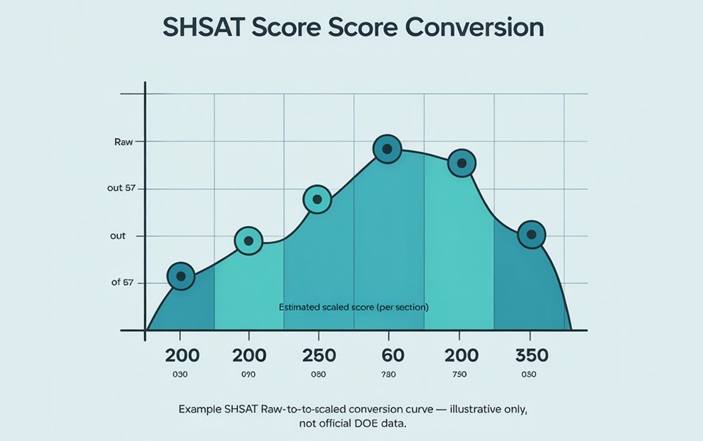
In other words, the curve is steeper near the top end. Very high raw scores in one section can have a big impact on your total scaled score. The exact formula is not public, but a calculator can use a reasonable curve to produce an estimated scaled score, such as:
- ELA scaled: ~200–350
- Math scaled: ~200–350
- Composite = ELA scaled + Math scaled → roughly 400–700
3- Composite score
Your final SHSAT score is the sum of your scaled scores:
Composite = ELA scaled + Math scaled
This composite is what matters for admissions decisions. Recent SHSAT composites for top schools are often in the high 500s and 600s, with cutoffs moving slightly each year based on:
- Test difficulty,
- Applicant pool,
- Number of available seats.
What the SHSAT score calculator does
The SHSAT score calculator described on your page is designed to:
- Take your raw ELA and Math scores (0–57 each),
- Apply a non‑linear scaling model to each section, and
- Produce an estimated composite score out of ~700.
Then, it compares your composite to recent cutoff score bands for four popular Specialized High Schools:
- Stuyvesant High School: 561–566
- Bronx Science: 521–532
- Brooklyn Technical HS: 498–510
- HSMSE at City College: 518–526
These numbers are approximate recent ranges, useful as targets for preparation.
1-Inputs
The calculator asks for:
- ELA raw score (0–57)- You can also use quick chips like 30, 40, 50 to test scenarios.
- Math raw score (0–57)- Again, quick chips are available for common raw scores.
- Target school (optional)– You can highlight a school (e.g., Stuyvesant) to see your score against its range.
2-Scaling model (approximate)
Because the official scale is secret, the tool uses an approximate non‑linear formula for each section:
- When raw scores are low, scaled scores stay close to the minimum (e.g., around 200).
- As raw scores go higher, the scaled score increases faster, especially near the top end.
This reflects the general idea that the SHSAT curve is steep near perfection.
Each section’s scaled score is then:
- Capped between roughly 200 and 350, and
- Then combined into a composite between around 400 and 700.
3- Outputs
After you click “Calculate scaled SHSAT score”, the calculator shows:
- ELA scaled score (approx.)
- Math scaled score (approx.)
- Estimated composite score (out of ~700)
…and a status summary for each school:
- Stuyvesant
- Bronx Science
- Brooklyn Tech
- HSMSE at City College
For each school, you’ll see something like:
- “In recent range”
- “Above recent range”
- “Slightly below – close to range”
- “Below recent range”
plus your estimated composite.
How to use the SHSAT score calculator (step by step)
Step 1: Take a realistic practice test
To get meaningful results:
- Use a full‑length practice exam that resembles the real SHSAT.
- Time yourself under real conditions (no phones, no breaks beyond what the test allows).
Then, count how many questions you got right in:
- ELA (out of 57)
- Math (out of 57)
Step 2: Enter your raw ELA and Math scores
In the calculator:
- Type your ELA raw score in the ELA field,
- Type your Math raw score in the Math field.
You can also tap the chip buttons (e.g., 30, 40, 50) to see what different raw scores might do to your scaled estimate.
Step 3: Choose a target Specialized High School
Select a target under “Highlight a target school”:
- Stuyvesant
- Bronx Science
- Brooklyn Tech
- HSMSE
This doesn’t change your score; it just highlights that school’s cutoff range in the results, making it easier to see if you’re in, above, or below that band.
Step 4: Click “Calculate scaled SHSAT score”
The shsat score calculator will:
- Check that your inputs are valid (0–57).
- Estimate your:
- ELA scaled score
- Math scaled score
- Composite score out of ~700
- Compare your composite to each school’s recent cutoff range and show a status badge:
- In recent range
- Above recent range
- Slightly below – close to range
- Below recent range
Step 5: Interpret the results carefully
- A higher raw score in one section (especially in the mid‑40s and up) can give you a strong boost because of the non‑linear scale.
- A composite well above a school’s recent cutoff band is a good sign, but not a guarantee of admission.
- A composite slightly below a cutoff band means you’re close—further improvements could make the difference.
- A composite well below a band is a sign you need to:
- Strengthen fundamentals, and
- Possibly adjust expectations or target a broader range of schools.
Tips for using a SHSAT score calculator effectively
1-Focus on practice, not perfection
Use the calculator to:
- Track your progress over time with regular practice tests.
- See how improving from, say, 35 to 42 raw in Math changes your estimated scaled score.
But don’t:
- Obsess over every single point,
- Forget that test day conditions and curve vary each year.
2- Aim high in at least one section
Because scaling is non‑linear, very strong performance in one section can have more impact than two moderate performances.
For example:
- ELA 50 raw + Math 35 raw can sometimes yield a better composite than ELA 42 + Math 42, depending on the curve.
The calculator helps you visualize how different raw combinations affect your score, so you can Decide where to invest extra effort, and Build on your natural strengths.
3- Use recent cutoffs as targets, not promises
Cutoff ranges like:
- Stuyvesant: 561–566
- Bronx Science: 521–532
- Brooklyn Tech: 498–510
- HSMSE: 518–526
are historical benchmarks, not fixed guarantees. Your composite might be Above a range and still not result in an offer, or Below a range but still work out if SHSAT score calculator with cutoff change, Depending on that year’s applicant pool and seat availability. Treat them as goalposts, not as strict pass/fail lines.
4- Pair this tool with targeted study
The calculator is most useful when you:
- Take full‑length timed practice tests,
- Review every question you missed,
- Use books, online resources, or tutors to fill specific gaps in: Reading comprehension, grammar, logical reasoning (ELA), Algebra, geometry, word problems (Math).
Watch your calculator results over multiple tests to see:
- Which section is improving,
- Whether your strategy changes (e.g., focusing more on ELA) move the needle.
5- Manage stress and expectations
Remember:
- A calculator can’t measure your potential on test day, only your current practice level.
- It’s normal for scores to fluctuate from test to test.
Use score estimates as data, not as your entire identity as a student. Your well‑being and long‑term success matter far beyond any single exam.
SHSAT score conversion chart
FAQs/ Frequently Asked Questions
You can explore Similar Calculator like this Free SCHD dividend calculator.